When the Word “Discount” Is More Powerful Than Motivation
There is a simple word that can change human behavior almost instantly: discount. It doesn’t sound extraordinary, yet its effect is often stronger than saving resolutions or minimalist lifestyles.
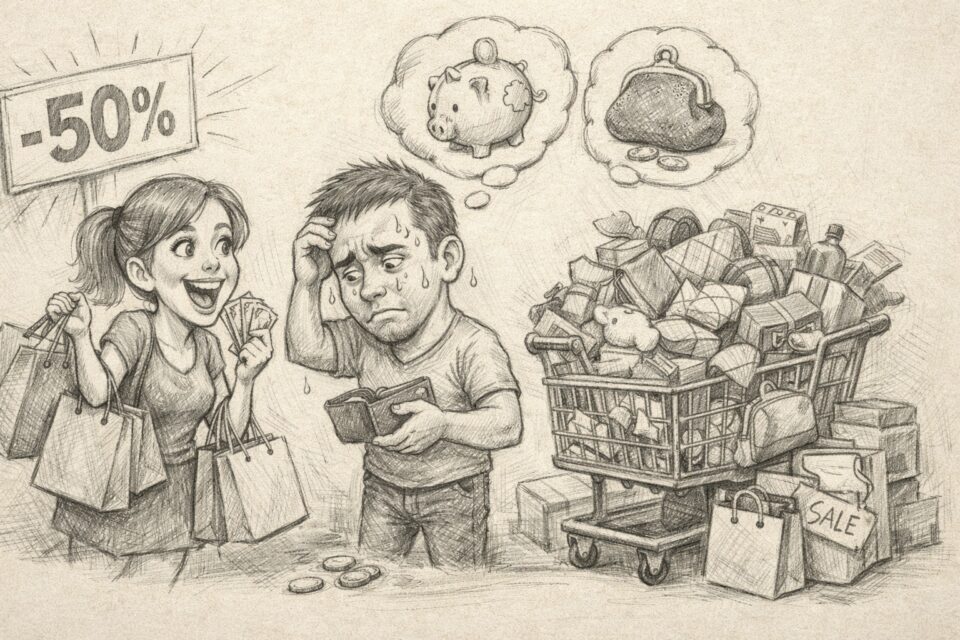
Someone might walk into a store just to “look around.” A harmless activity. But the moment they see the word SALE, the relaxed stroll quietly transforms into a shopping mission. Minutes later, the same person walks out carrying bags that were never part of the original plan.
This phenomenon is common. The intention is to save money. The outcome is often the opposite.
Discounts: A Financial Illusion That Feels Like Winning
Discounts often create the sensation of a small victory. When a price drops from $50 to $19, the brain doesn’t focus on the $19 being spent. Instead, it celebrates the $31 saved.
This shift in perception makes the purchase feel rational, even smart. In reality, money still leaves the bank account.
Human psychology tends to fear missing opportunities more than losing money. When a discount appears, not buying can feel like wasting a rare chance. Buying, therefore, seems perfectly reasonable.
Retail Strategies That Are Quietly Brilliant
Retailers understand this behavior very well. As a result, various strategies are designed to make discounts look irresistible.
One classic trick is increasing the original price first and then applying a large discount. The result is a dramatic illusion of savings.
Large percentage numbers also have strong psychological power. Seeing “70% OFF” often feels like a once-in-a-lifetime opportunity.
In reality, such discounts are frequently applied to older stock or products the store simply wants to clear.
The Illusion of the Original Price
The crossed-out original price plays an important role in the drama of discounts. It creates a visual story where the new price appears heroic.
Seeing $50 crossed out and replaced with $19 can feel like hitting a small jackpot. The brain focuses on the difference rather than the actual spending.
Humans are highly influenced by comparisons, which makes this strategy remarkably effective.
“Today Only!”: Time Pressure That Disrupts Logic
Discounts are often paired with urgency. Phrases like “Today Only,” “Flash Sale,” or “Limited Stock” push people to decide quickly.
When time feels limited, the brain switches to fast decision-making mode. Careful analysis disappears. What remains is the fear of missing out.
Scarcity creates perceived value—even when the scarcity itself is manufactured.
FOMO: The Collective Fear Retail Loves
Fear of Missing Out, or FOMO, fuels modern discount culture.
When people see others getting great deals, a subtle feeling emerges: Why didn’t I get that too?
Social media amplifies this effect. Major sales events often feel like national celebrations. Timelines fill with checkout screenshots, package deliveries, and stories of “winning” a deal.
Shopping becomes a shared experience rather than just a transaction.
Discounts Make Us Buy Things We Don’t Need
The real problem with discounts is not the lower price—it’s the unnecessary purchases.
Many buying decisions begin with a simple justification: “It’s cheap anyway.”
A few days later, a different question appears: “Why did I buy this?”
The item then sits quietly in a closet, rarely used, occupying space like a silent tenant.
Bundle Deals and “Buy More to Save More”
Another common tactic is bundling. Statements like “cheaper if you buy three” sound logical.
But simple math often gets ignored. If someone only needs one item, buying three still means spending more money.
Bundle discounts make spending look efficient, even when it isn’t.
Free Shipping: The Modern Shopping Magnet
In online shopping, the phrase free shipping holds incredible power.
Many people add extra items to their cart simply to reach the minimum requirement for free delivery.
Ironically, those additional items sometimes cost more than the shipping fee they were trying to avoid.
It’s a small mathematical paradox: spending money to “save” money.
Psychological Pricing Tricks
Prices like $9.99 feel significantly cheaper than $10, even though the difference is minimal.
The human brain reads numbers from left to right. Because of that, $9.99 feels closer to nine dollars than ten.
This simple technique has been used for decades—and it still works remarkably well.
Discounts and the Dopamine Effect
Discount shopping also triggers a neurological response. When people feel they’ve secured a great deal, the brain releases dopamine, a chemical linked to pleasure.
The sensation resembles a small win in a game.
As a result, shopping becomes a form of instant entertainment. However, entertainment can become expensive if repeated too often.
When “Saving” Turns Into Overconsumption
There is an important difference between buying something cheaply and buying too much.
Buying cheaply means purchasing something needed at a lower price. Buying too much means spending money simply because the price looks attractive.
Ten cheap items that go unused are still ten unnecessary expenses.
How to Stay Rational When Seeing Discounts
Avoiding discount traps doesn’t mean rejecting all promotions. It simply requires awareness.
A simple question helps: Would I still buy this if there were no discount?
If the answer is no, the purchase is probably driven by the promotion rather than actual need.
Taking a short pause before checking out can also help. Sometimes one night of reflection is enough to realize the item isn’t really necessary.
Saving Is About Decisions
Discounts are not the enemy. They can help consumers pay less for things they genuinely need.
But discounts are not automatically friends of your wallet either. If every promotion leads to another purchase, the illusion of saving quickly disappears.
In the end, saving money isn’t determined by price tags or percentage cuts.
It’s determined by decisions.