The Modern Paradox: Running in Place in a High-Speed World
We inhabit an era of unprecedented velocity. Our devices hum with the promise of efficiency, yet a pervasive sense of temporal famine haunts the modern professional. We are perpetually breathless, sprinting through a landscape of digital noise, only to realize at sunset that we haven’t moved an inch toward our true North. This is the great stagnation of the digital age: a frantic, kinetic energy that yields remarkably little substance.
The Mirage of the To-Do List
The humble to-do list has evolved from a simple mnemonic device into a psychological labyrinth. We populate these lists with a flurry of administrative minutiae, mistaking the sheer volume of checkmarks for actual progress. It is an optical illusion of achievement. By prioritizing the quantifiable over the qualitative, we succumb to a shallow satisfaction that evaporates the moment we face a complex, looming project.
Why “Busy” Has Become Our New Status Symbol
In contemporary society, busyness is often paraded as a badge of merit. To be “slammed” or “underwater” is to signal one’s indispensability and social capital. We have pathologized leisure, viewing unscheduled time as a vacuum that must be filled with industriousness. This performative exhaustion serves as a social lubricant, yet it masks a hollow reality where our identities are anchored to the frequency of our movements rather than the weight of our contributions.
The Neurological Trap of the “Urgency Effect”
Our biology is frequently at odds with our long-term ambitions. The human brain is evolutionarily hardwired to respond to immediate stimuli—the rustle in the grass or, in a modern context, the red notification badge. This “urgency effect” creates a cognitive bias where we prioritize time-sensitive tasks regardless of their objective importance.
Why Our Brains Choose Easy Tasks Over Important Ones
Faced with a choice between a grueling strategic report and the simple act of filing expenses, the brain instinctively leans toward the path of least resistance. This is known as “cognitive ease.” Completing minor tasks provides a quick hit of satisfaction, allowing us to maintain a facade of productivity while effectively stalling on the high-stakes work that actually moves the needle.
The Dopamine Hit of the Notification Ping
Every digital alert triggers a micro-burst of dopamine, the neurotransmitter associated with reward and anticipation. We have become Pavlovian subjects, salivating at the chime of an incoming message. This intermittent reinforcement keeps us tethered to our screens, fracturing our attention span into a million jagged shards and making sustained contemplation nearly impossible.
How Cognitive Load Shreds Our Ability to Focus
Our working memory is a finite resource. When we saturate our minds with a cacophony of open tabs, unread Slack messages, and half-formed thoughts, we hit a state of cognitive overload. This mental clutter creates a “processing lag,” reducing our intellectual capacity to a mere fraction of its potential and leaving us feeling mentally bankrupt by noon.
The Difference Between Motion and Action
There is a vital, often ignored distinction between being in motion and taking action. Motion is the preparation for a task—the research, the organizing, the “getting ready.” Action is the actual execution. While motion feels like work, it is often just a sophisticated form of treading water.
The “Activity Trap” Explained
The activity trap is the phenomenon of becoming so embroiled in the tactical execution of daily chores that one loses sight of the strategic objective. It is the hallmark of the “functional procrastinator.” We spend our days in a whirlwind of motion, yet we fail to produce any tangible, transformative output.
Identifying High-Leverage vs. Low-Leverage Work
To escape the trap, one must apply the Archimedean principle of leverage. High-leverage work is characterized by tasks where a small input of focused energy yields a disproportionately large result. Conversely, low-leverage work involves repetitive, low-impact chores that consume vast quantities of time with negligible ROI.
Why Clearing Your Inbox Isn’t Real Progress
The quest for “Inbox Zero” is perhaps the most seductive distraction of the modern workplace. Email is, by definition, a list of other people’s priorities. By dedicating our most creative hours to the management of correspondence, we allow the agenda of the world to supersede our own creative mandates.
The Stealthy Productivity Killers We Ignore
Many of our most significant obstacles are baked into the very structure of the modern office environment. They are the invisible friction points that erode our efficiency.
Context Switching: The Hidden Tax on Your Brain
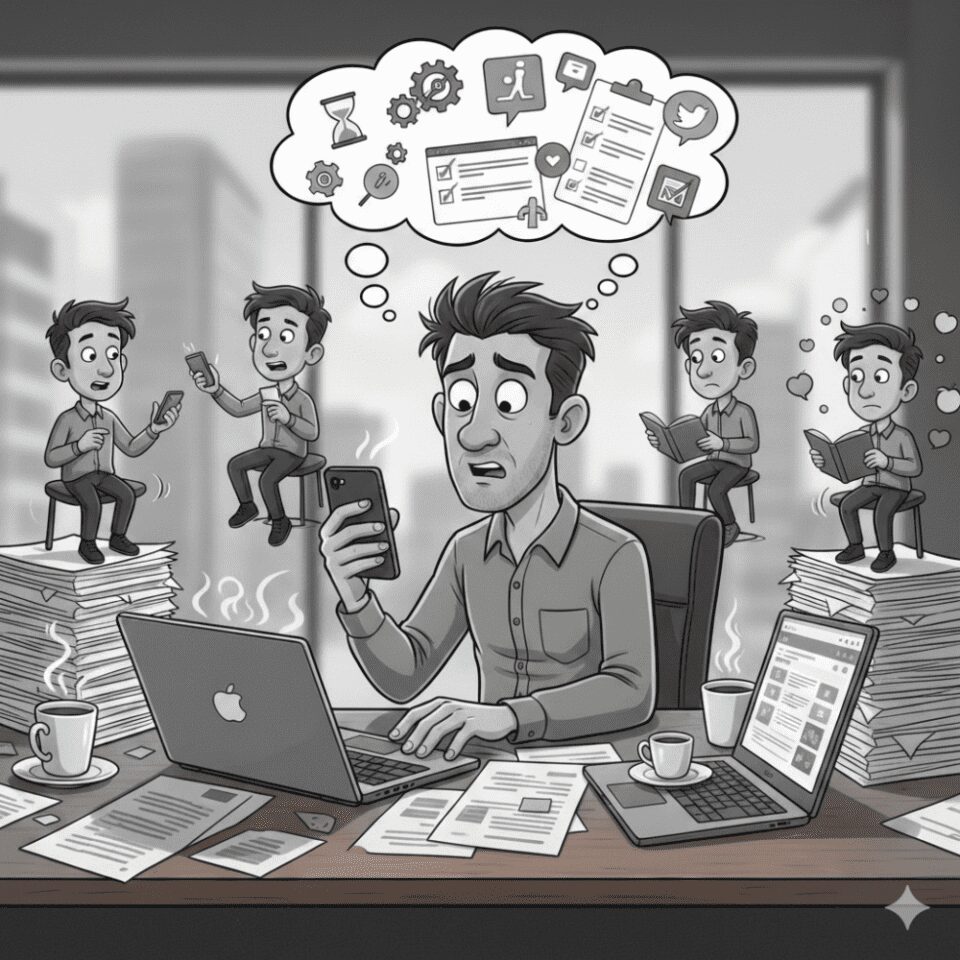
Every time we pivot from one task to another, we pay a “switching cost.” It takes the brain several minutes to fully recalibrate to a new context. If you check your phone every ten minutes, you are effectively living in a state of permanent mental fog, never reaching the cognitive depth required for excellence.
The Meeting That Should Have Been an Email
The corporate calendar is often a graveyard of lost hours. Synchronous communication is frequently used as a crutch for poor planning or a lack of individual decision-making. These gatherings fragment the day, leaving only small, unusable slivers of time between appointments.
Decision Fatigue and the Afternoon Slump
The capacity to make sound choices is a depletable energy source. By the time the afternoon rolls around, having spent the morning navigating a thousand minor dilemmas, our willpower is spent. This exhaustion leads to “analysis paralysis” or, worse, the impulsive selection of the easiest possible option.
The Myth of the Master Multitasker
Neuroscience is unequivocal: the human brain cannot multitask. What we perceive as multitasking is actually rapid “task-switching.” This process is exhausting and error-prone, reducing IQ scores more significantly than losing a full night of sleep.
Psychological Barriers to True Output
Sometimes, the call is coming from inside the house. Our own psychological defense mechanisms often sabotages our productivity.
Procrastination in Disguise: “Productive” Avoidance
We often engage in “procrastivity”—the act of doing something productive to avoid doing something more important. Cleaning the entire office instead of writing the first chapter of a book feels virtuous, but it remains an act of avoidance.
The Perfectionism Paralysis
Perfectionism is not a pursuit of excellence; it is a shield. By setting an impossibly high bar, we create a convenient excuse to never start or never finish. The fear of producing something mediocre keeps us locked in a state of eternal preparation.
Fear of Failure vs. Fear of Finishing
Interestingly, the fear of completion can be just as potent as the fear of falling short. Finishing a project subjects it to the cold light of public judgment. As long as it is “in progress,” it remains a perfect, unassailable idea.
Reclaiming the Narrative: From Busy to Purposeful
To break the cycle of frantic stagnation, we must redesign our relationship with work. It requires a shift from a philosophy of volume to a philosophy of value.
The Power of “Deep Work” in a Shallow World
Cultivating the ability to focus without distraction on a cognitively demanding task is the “superpower” of the 21st century. Deep work allows us to master complicated information and produce better results in less time.
Establishing Your “Big Rocks” First thing in the Morning
Borrowing from Stephen Covey’s analogy, we must place our “big rocks”—our most significant priorities—into the jar of our day first. If we fill the jar with sand (minutiae) and pebbles (emails) first, the big rocks will never fit.
Why Saying “No” is a Productivity Superpower
Every “yes” to a trivial request is a “no” to a significant goal. Selective radicalism in protecting one’s time is essential. Professional efficacy is built on the ruins of projects you had the courage to decline.
Designing a Low-Friction Environment
Willpower is a fickle friend. Instead of relying on discipline, we should engineer our environment to make the right choices easy. This means physical boundaries, digital blockers, and a workspace that signals focus rather than chaos.
Sustainable Success and the Art of Doing Less
True productivity is not about cramming more tasks into the day; it is about extracting more value from the tasks we choose to keep.
The Importance of Strategic Idleness
The “incubation period” is vital for creativity. Moments of deliberate boredom and strategic idleness allow the subconscious to synthesize information. Some of the greatest breakthroughs in history occurred not at a desk, but during a walk or a daydream.
Shifting the Metric: Results Over Hours Logged
We must decouple our self-worth from the clock. A four-hour window of intense, high-leverage work is infinitely more valuable than a twelve-hour day spent in a state of distracted semi-consciousness.
Closing the Loop: Finding Satisfaction in the “Done” List
Finally, we must learn to celebrate the “done” list. By acknowledging the completion of significant milestones, we rewire our brains to seek the long-term satisfaction of meaningful contribution over the fleeting buzz of digital busywork.