
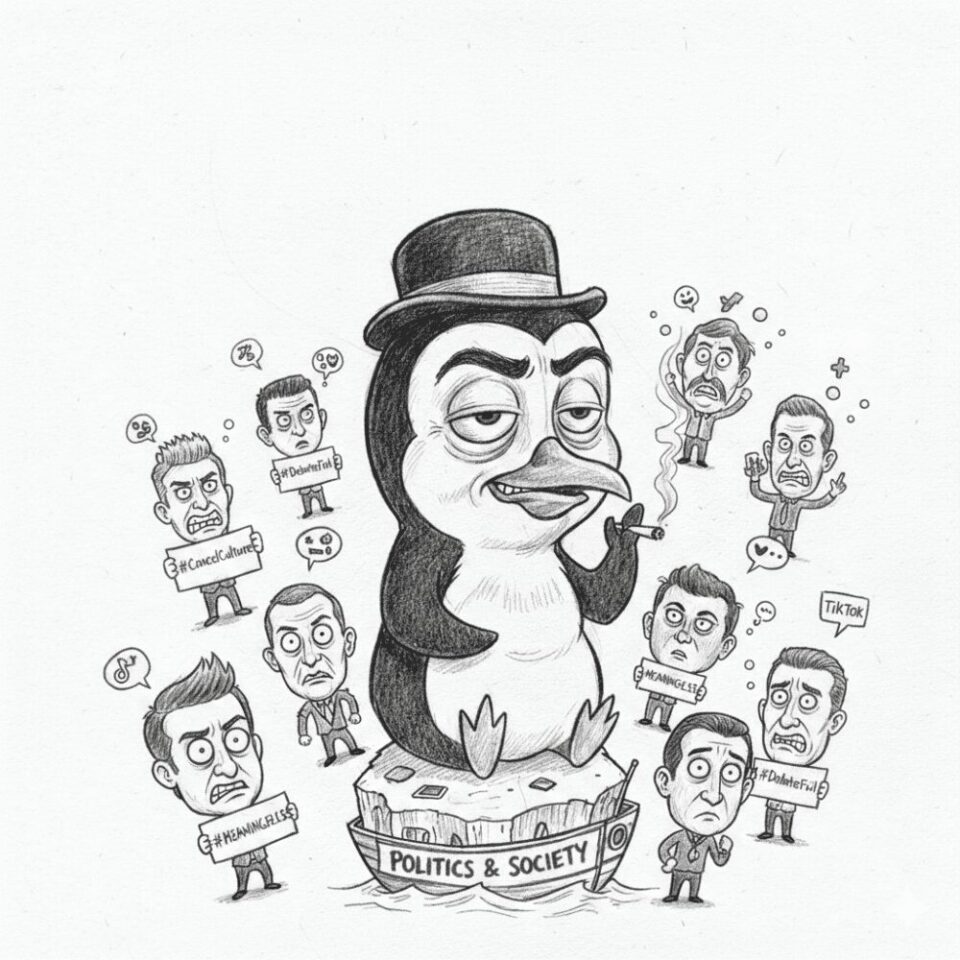
At first glance, the “Nihilist Penguin” meme looks innocuous. A squat, wide-eyed bird. A flat caption. A joke that lands with a dull thud rather than a punchline. And yet, this unassuming image has waddled into a far more serious arena. What began as a piece of dark internet humor has evolved into a cultural Rorschach test—eliciting laughter, discomfort, and debate in equal measure. The penguin is no longer just funny. It is symptomatic.
What Is the “Nihilist Penguin” Meme?
The meme typically features a cartoonish or stock-image penguin paired with captions that express bleak, deadpan observations about meaninglessness, futility, or societal collapse. The humor is dry. Sometimes brutal. Often unsettling in its calm acceptance of despair.
The Visual Language of the Penguin
Visually, the penguin is doing most of the work. Its rounded body, blank stare, and clumsy posture evoke innocence and vulnerability. There is no aggression here. No menace. The image disarms the viewer before the text delivers its quiet blow. This visual softness makes the message more jarring, not less.
The Core Joke: Humor Rooted in Existential Dread
The joke is not a joke in the traditional sense. It is an acknowledgment. A shrug at the void. The humor emerges from recognition rather than surprise, from the uneasy relief of seeing private anxieties articulated in public, meme-ready form.
Tracing the Meme’s Origins
Like many cultural artifacts of the internet age, the “Nihilist Penguin” does not have a clean origin story. It surfaced gradually, accruing meaning through repetition and variation.
Early Appearances on Niche Internet Forums
Early iterations appeared on anonymous message boards and niche forums where bleak humor thrives. These were spaces already steeped in irony and disaffection, where sincerity was suspect and optimism treated as naïveté.
The Role of Absurdist and Dark Humor Communities
Absurdist meme communities played a critical role in shaping the tone. Here, meaninglessness was not feared but embraced, rendered humorous through exaggeration and emotional detachment. The penguin fit seamlessly into this aesthetic ecosystem.
Why Penguins? The Power of an Unlikely Mascot
Penguins are not obvious candidates for existential symbolism. That is precisely the point.
Cute Imagery as a Vehicle for Bleak Messages
Cuteness lowers defenses. It invites engagement. When paired with nihilistic text, it creates cognitive dissonance that makes the message linger. The viewer laughs, then pauses, then wonders why the joke feels uncomfortably true.
Contrast as a Memetic Strategy
Contrast is a foundational memetic strategy. The greater the distance between image and message, the stronger the impact. The penguin’s benign charm intensifies the bleakness of the sentiment, sharpening its satirical edge.
From Laughs to Think Pieces: The Meme Breaks Containment
What was once confined to meme pages began appearing in broader digital conversations. Screenshots escaped their original contexts.
Viral Acceleration on Mainstream Platforms
As the meme spread to platforms with larger, more heterogeneous audiences, its interpretation fractured. What was once an inside joke became fodder for discourse, commentary, and critique.
When Irony Meets Algorithmic Amplification
Algorithms are indifferent to nuance. Content that provokes strong reactions—amusement, outrage, unease—travels faster. The penguin’s ambiguous tone made it particularly combustible in attention-driven ecosystems.
The Meme’s Philosophical Undercurrents
Beneath the humor lies a thicket of philosophical ideas, condensed and simplified for rapid consumption.
Nihilism Explained for the Internet Age
The meme gestures toward nihilism not as a rigorous philosophy, but as a mood. A shorthand for exhaustion with grand narratives, promises unfulfilled, and futures perpetually deferred.
Existentialism, Absurdism, and Meme Culture
Echoes of Camus and Sartre surface, albeit filtered through irony. The absurdity of existence is not confronted with rebellion or responsibility, but with a sigh and a punchline.
A Mirror of Modern Malaise
The popularity of the meme is inseparable from the context in which it thrives.
Economic Anxiety and Generational Disillusionment
For younger generations facing precarious labor markets and eroding social contracts, nihilistic humor becomes a vernacular of survival. The penguin speaks a language many already know fluently.
Climate Fear, Political Fatigue, and Cultural Burnout
Overlay this with climate anxiety, political polarization, and perpetual crisis, and the meme begins to look less like escapism and more like reportage—emotional journalism in miniature.
The Political Turn: When the Meme Gets Serious
Inevitably, the meme crossed into explicitly political territory.
Adoption by Activists and Commentators
Activists and commentators began repurposing the penguin to critique systems, institutions, and ideologies. The humor remained, but the targets sharpened.
Weaponized Irony in Online Discourse
Irony became a shield and a sword. It allowed statements to be made without full accountability, cloaked in humor while still delivering ideological payloads.
Apolitical or Deeply Political? Competing Interpretations
Disagreement over the meme’s meaning is central to its endurance.
The Case for the Meme as Pure Satire
Some argue the penguin is simply a joke—a reflection of mood, not a manifesto. In this reading, any political interpretation is overreach.
The Argument for Inherent Ideology
Others contend that disengagement itself is political. That expressing futility in the face of systemic issues reinforces the status quo by normalizing resignation.
How Different Political Groups Use the Meme
The meme’s ambiguity makes it highly adaptable.
Left-Leaning Readings and Systemic Critique
On the left, the penguin often becomes a symbol of late-capitalist despair, highlighting structural inequities and institutional failure with sardonic brevity.
Right-Leaning Appropriations and Anti-Establishment Messaging
On the right, it can signal distrust of authority, media, and governance—less a call for reform than a gesture of cynical withdrawal.
The Media Weighs In
Eventually, traditional media took notice.
Headlines, Hot Takes, and Cultural Explainers
Articles proliferated, attempting to decode the meme’s appeal and significance. Some treated it as a curiosity. Others as a warning sign.
Meme Literacy in Newsrooms
The coverage exposed a broader gap in meme literacy, as journalists grappled with formats that resist linear interpretation.
Generational Divides in Reading the Joke
Not everyone laughs for the same reasons.
Gen Z’s Fluency in Ironic Despair
For Gen Z, irony is a native tongue. The penguin’s bleakness reads as honesty, not defeatism.
Older Audiences and the Limits of Meme Context
Older viewers, lacking the same contextual fluency, may read the meme literally—missing the layers of performative detachment beneath.
The Ethics of Laughing at Nothingness
The meme raises uncomfortable ethical questions.
Does Nihilistic Humor Normalize Apathy?
Critics worry that repeated exposure to nihilistic messaging dulls the impulse to act, replacing engagement with detached amusement.
Or Does It Offer Catharsis and Connection?
Supporters argue the opposite: that shared humor creates solidarity, a pressure valve for collective anxiety.
Commercialization and Co-Opting
As with all successful memes, commercialization followed.
Brands Flirting with Existential Humor
Some brands attempted to harness the aesthetic, deploying sanitized nihilism to appear relatable. The results were mixed.
When the Meme Loses Its Edge
Once commodified, the penguin’s subversive power diminishes. Irony marketed at scale often collapses under its own self-awareness.
The Backlash Against the Penguin
Not everyone is amused.
Critics Who See Harm in Hopeless Humor
Mental health advocates and cultural critics have raised concerns about the normalization of despair, especially among vulnerable audiences.
Accusations of Cynicism and Detachment
The meme has been accused of promoting emotional disengagement, a retreat from responsibility disguised as wit.
Meme as Cultural Text
Academics have begun treating the meme as more than ephemera.
How Scholars and Critics Analyze the Phenomenon
From media studies to philosophy, the penguin is dissected as a compressed cultural artifact, rich in implication despite its simplicity.
The Penguin in the Tradition of Political Cartoons
Like political cartoons before it, the meme distills complex realities into a single, repeatable image—blunt, ironic, and instantly legible.
Global Variations of the Meme
The penguin travels well.
How Different Cultures Adapt the Joke
Localized versions reflect regional anxieties, swapping references while preserving the core sentiment of existential fatigue.
Universal Themes, Local Anxieties
Meaninglessness, it seems, is a global language—even if its dialects differ.
Longevity or Flash in the Pan?
The internet moves quickly. Memes age faster than milk.
Signs the Meme Has Staying Power
Its adaptability, philosophical depth, and emotional resonance suggest a longer shelf life than most viral content.
The Internet’s Short Attention Span
Still, attention is fickle. Today’s cultural touchstone is tomorrow’s archived screenshot.
What the “Nihilist Penguin” Says About Us Now
Ultimately, the meme is less about a penguin than about people.
Humor as a Coping Mechanism
In an era of compounding crises, humor becomes triage—imperfect, but necessary.
Memes as Soft Political Commentary
Memes like this function as low-friction political commentary, shaping attitudes subtly, one laugh at a time.
Conclusion: More Than a Joke, Less Than a Manifesto
The “Nihilist Penguin” meme occupies an uneasy middle ground. It is not a call to arms. Nor is it empty frivolity. It is a cultural shrug rendered adorable, a quiet acknowledgment that many feel adrift. In that tension—between laughter and resignation—the penguin finds its power, and its controversy.